Why Is Whole Life Insurance So Expensive? Is It Even Worth It?
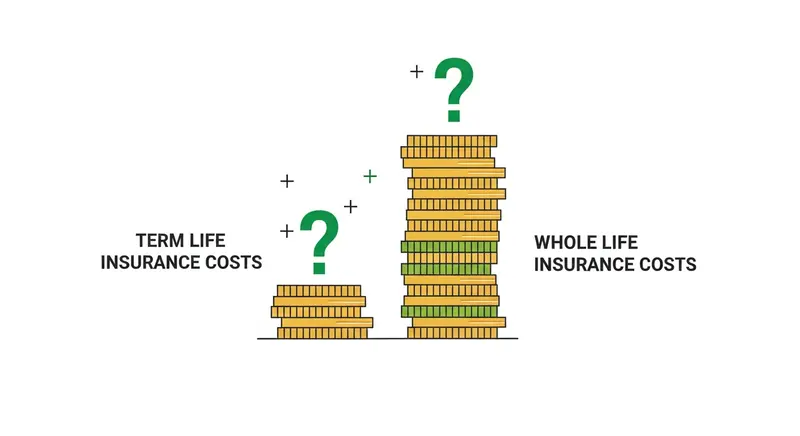
So you got a quote for whole life and your jaw just hit the floor. Like, $30 for term and suddenly $250 or more for this? What gives?
You're not being scammed, honestly. Whole life really costs that much. But it's not always a bad deal; it just depends on what you need. Let's look at why it costs so much more than term.
Why Whole Life Costs So Much More Than Term
There are three main reasons the price jumps up:
- It covers you for your entire life. Term is basically renting coverage for 10, 20, or 30 years. The company bets you'll outlive the term, and usually, they're right. Whole life is buying it for good. They know they'll pay out eventually, and they charge for that certainty.
- It builds cash value. Part of your premium goes into a savings account that grows at maybe 2-4% a year. You can borrow against this or cash it out if you leave the policy. It's insurance mixed with a forced savings account.
- Premiums are locked in forever. The rate you pay at 30 is what you pay at 70. Since you're way more expensive to insure when you're older, they front-load the cost to keep it flat for decades.
The Real Cost Difference: Term vs. Whole Life
Think about a healthy 35-year-old looking at $500,000 in coverage:
- 20-year term: $25-40 per month
- Whole life: $300-500 per month
That's roughly 10 times the cost for the same payout. Over 20 years, you'd spend $7,200 on term versus $84,000 on whole life. You might have $40,000-60,000 in cash value by then, but you paid an extra $76,800 to get it. The math isn't always pretty.
When Whole Life Insurance Actually Makes Sense
It's not a bad product, just niche. It works well if:
- You're doing estate planning. If you have big assets, it's a way to leave a tax-free inheritance or help with estate taxes via a trust.
- You have lifelong dependents. Like a child who will need care their whole life. You need to know the money is there no matter when you pass.
- You struggle to save money. It forces you to set cash aside every month. It's not the most efficient way to save, but it works if you're a spender.
- You need extra retirement income. If your 401(k) and IRA are already maxed out, this is another place to put money for later.
When Whole Life Does Not Make Sense
For most people, it's not the right fit:
- You just need income replacement. If you're covering the mortgage and kids' expenses for 20-30 years, term is way cheaper and does the job.
- You're on a tight budget. That extra $260-460 a month could be working harder for you in an index fund.
- You're young. Lock in cheap term now and see where you are in 20 years.
- You're being sold on it as an investment. Be skeptical if someone calls it "being your own bank." The returns are pretty modest compared to the stock market.
The "Buy Term and Invest the Difference" Strategy
This is classic advice for a reason. You buy cheap term and invest the $320 a month you saved compared to the whole life premium. If you invest that $320 at a 7% return for 20 years, you're looking at over $165,000. That beats the $40,000-60,000 cash value easily. This works if you're disciplined. If you're not, maybe the forced savings is better.
The Bottom Line
Whole life is pricey because it's lifelong coverage with a built-in savings bucket. It has its place. But for most families, term is the move. It gets you through the years where your income is crucial at a price that doesn't break the bank. Because the bills don't stop.
See Both Options Side by Side
MyMesi lets you compare term and whole life quotes from top carriers in about 2 minutes. No pressure, no sales stuff. Just numbers so you can decide.