Life Insurance for Renters: Do You Need Coverage If You Don't Own a Home?
There’s this weird myth going around that life insurance is only for people with mortgages. You know, people always say, "I don't have a mortgage, so why would I need life insurance?"
Sounds like it makes sense, right? But it’s actually totally wrong.
Here’s the thing: your family’s bills don’t just vanish if something happens to you. Rent still comes due. You still have to buy food. The car payment doesn’t pause. Even childcare doesn’t give you a break just because things got tough. Basically, the bills keep coming regardless.
Rent Is Still a Massive Monthly Obligation
The average rent in the U.S. is over $1,700 a month. In a lot of cities, you’re looking at $2,000 to $3,500. That’s like $20,000 to $40,000 a year just so your family has a place to sleep.
If your income is gone, who is going to cover that? Your partner might be okay for a couple of months, but what happens when you hit month six? Or a year later?
A life insurance policy is basically a financial safety net. It’s not about getting rich. It’s just about making sure the rent, groceries, and electric bill still get paid so your family doesn't have to scramble.
What Renters Actually Need to Cover
When you don't own a home, your needs are actually pretty similar to everyone else’s. Here is the stuff you should add up:
Monthly bills your family needs covered:
- Rent: $1,500-3,000 per month
- Utilities (electric, gas, water, internet): $200-400 per month
- Groceries: $400-800 per month
- Car payment: $300-600 per month
- Car insurance: $100-200 per month
- Childcare: $800-2,000 per month per child
- Health insurance: $300-700 per month
- Phone and streaming services: $100-200 per month
Add up your monthly total. For most families, you're looking at $3,700 to $8,000 a month in costs that don't just go away.
Multiply that by the number of months your family needs help. Usually, you want to aim for 10 to 15 years of income replacement. That’s 120 to 180 months.
Example: If your family spends $4,500 a month and you want to cover them for 15 years, you’re looking at needing about $810,000. That’s not a made-up scary number; that’s just basic math based on what it actually costs to live.
How Much Coverage Do Renters Need?
Here’s a rough way to look at it:
If you’re single with nobody else depending on you:
- Just cover your debts like student loans or car loans.
- Add $10,000 to $15,000 for funeral costs.
- You’re probably looking at $50,000 to $150,000 total.
If you have a partner but no kids:
- Cover about 5 to 10 years of shared costs.
- Make sure the debts are taken care of.
- Plus final expenses.
- That’s usually $250,000 to $500,000.
If you have kids:
- Aim for 10 to 20 years of living expenses.
- Don’t forget childcare costs.
- Factor in the debts and maybe a little for education.
- Plus funeral costs.
- You’re likely looking at $500,000 to $1,000,000 or more.
Real Examples for Renters
Jasmine, 32, Single Parent
- Rents a 2-bedroom for $1,800/month.
- Has a 4-year-old.
- Her bills are $4,200/month.
- She grabbed a $750,000, 20-year policy.
- It costs her $32 a month.
If Jasmine wasn't around, that $750,000 means her daughter is taken care of through high school and beyond.
Kevin and Lisa, 29 and 31, Married, No Kids
- Rent is $2,200/month.
- Total bills: $5,100.
- Both work, but losing either income would be rough.
- They each got $400,000, 20-year policies.
- Costs them $38/month together.
They get peace of mind knowing they won't have to move if something happens.
Omar, 27, Single
- Rents a studio for $1,400/month.
- Has $32k in student loans (mom co-signed).
- Sends $300 a month to his parents.
- Got a $200,000, 20-year policy.
- Costs him $13/month.
Omar’s mom isn't stuck with his loans, and his parents have a safety net.
The Renter vs. Homeowner Myth
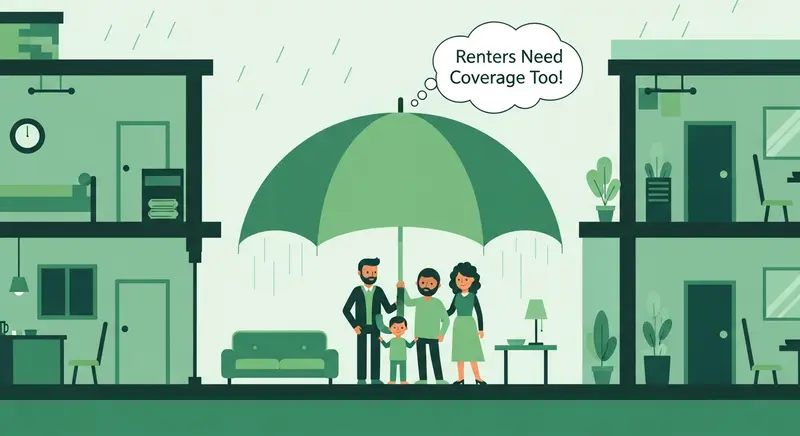
People think you only need insurance if you own a house, but look at it this way: if you pay $2,000 in rent versus $2,000 in mortgage, the money leaving your account is exactly the same. The house doesn't care who owns it; the landlord or the bank still needs their payment. Your family’s needs depend on your income and your bills, not on a deed.
What Happens If You Buy a Home Later?
Don’t stress about buying now. Most policies can change with you. If you become a homeowner in five years, you can usually add to your policy or look into conversion options. Getting covered now just locks in a rate based on your health today, which is almost always cheaper.
The Bottom Line
You don’t need to own a home to need life insurance. You need it if your death would leave people in a financial hole. It’s just a bridge that keeps the lights on and the fridge full. Because the bills don't stop.
Get Your Quote in 2 Minutes
Whether you rent or own, MyMesi makes it easy to see your real numbers. Compare quotes from top-rated carriers in about 2 minutes. No pressure. No obligations. Just honest numbers for your situation.